If you've ever run an educational document through automated translation software, you've probably seen the result: grammatically correct sentences that feel cold, awkward, or out of touch with families' cultural realities.
In family engagement, where trust, emotion, and relational safety matter most, literal translation isn't enough. Standard translations often miss the warmth, nuance, and cultural wisdom that make parenting strategies resonate in Latino households.
At Frankly, we made a foundational decision from day one: our Spanish version is a transadaptation, not a translation. In many ways, it is a distinct cultural version of its own.
Here is how we went past basic localization to build tools that respect both English- and Spanish-speaking communities.
1. Grounded in culture: from P.A.R.E.N.T. to P.A.D.R.E.S.
Our core English framework is the P.A.R.E.N.T. model, an evidence-based structure rooted in Trust-Based Relational Intervention (TBRI) and developmental neuroscience:
- Presence
- Attunement
- Regulation
- Empowerment
- Nurturing
- Teaching
Translating those six letters directly into Spanish would produce an awkward, disconnected acronym. Instead, we rebuilt the framework as P.A.D.R.E.S., an acronym that speaks directly to Spanish-speaking caregivers and keeps all of the underlying developmental science.
| English framework |
Spanish transadaptation |
| P: Presence |
P: Presencia |
| A: Attunement |
A: Afinidad / Afecto |
| R: Regulation |
D: Dominio / Autorregulación |
| E: Empowerment |
R: Resiliencia |
| N: Nurturing |
E: Empatía / Estímulo |
| T: Teaching |
S: Sabiduría |
By framing the science around Sabiduría (wisdom) and Afinidad (attunement and affection), the Spanish framework reflects the relational values, familismo and respeto, that anchor Latino home life.
2. Tested with parents and grandparents (abuelitos)
Science without cultural validation falls flat. To make sure our content felt authentic across generations, we piloted our parenting prompts and videos with focus groups of Spanish-speaking parents, mothers, and grandparents (abuelitos).
Multigenerational households play a central role in Latino student success. Grandparents are often primary caregivers who shape the emotional climate at home. Bringing abuelitos into our testing helped us keep our tone respectful, warm, and accessible, never clinical or condescending.
The testing also showed us which everyday phrases needed real transadaptation instead of direct conversion.
The idiom challenge: "Sticks and stones"
One of our English scripts on emotional regulation and resilience used the classic nursery rhyme:
"Sticks and stones may break my bones, but words will never hurt me."
A literal translation ("Las piedras y los palos pueden romper mis huesos...") makes no sense in Spanish-speaking cultures. No direct equivalent carries the same rhythm or cultural meaning.
Instead of forcing a literal translation, our team rewrote the concept from scratch. We drew on familiar metaphors and everyday Spanish expressions that convey emotional boundaries and resilience in a way a Spanish-speaking caregiver understands immediately and feels in their heart.
3. A commitment to both communities: launching Frankly Lotería
Our commitment to bilingual equity goes beyond digital tools to physical, hands-on family engagement.
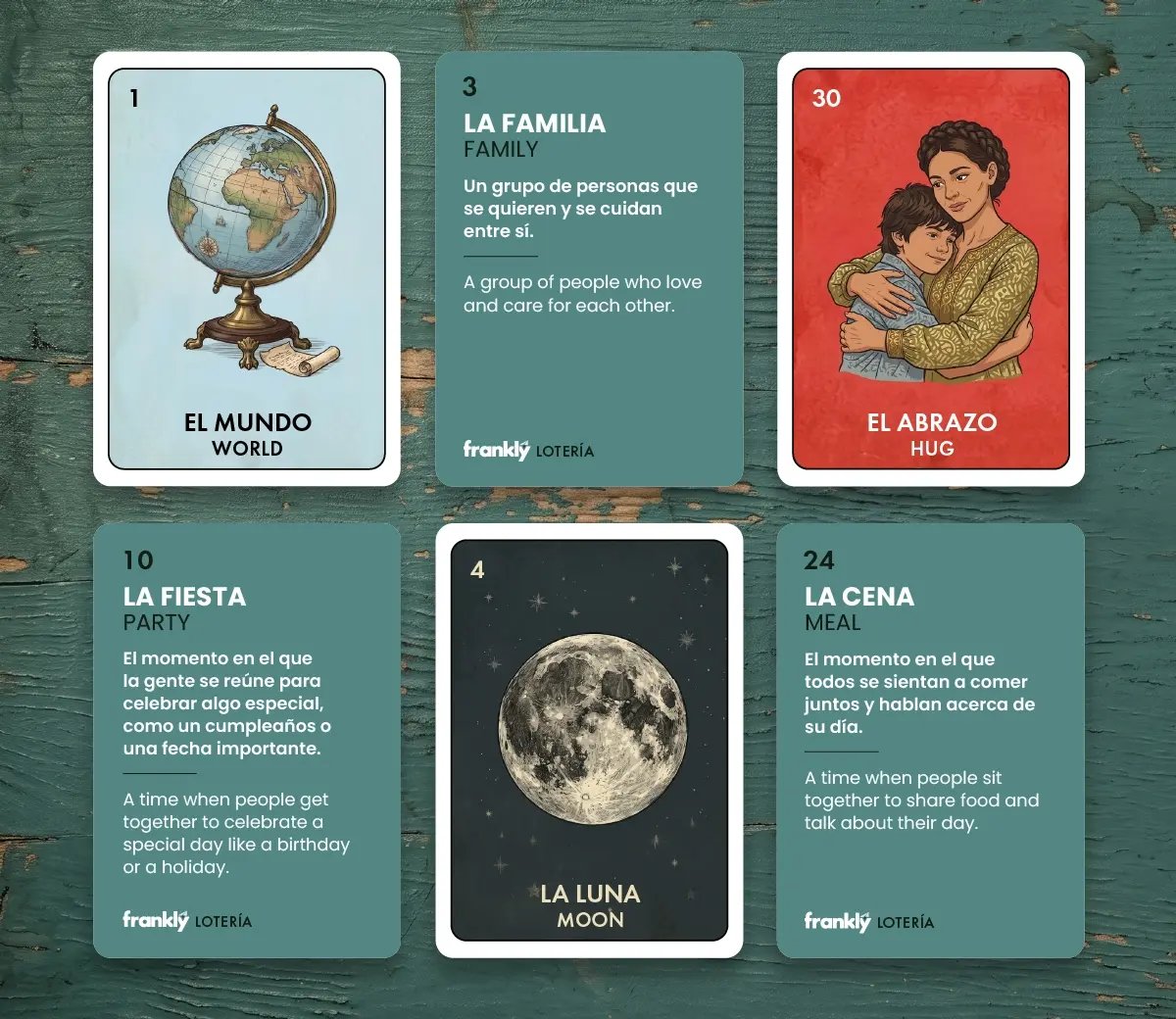
To connect home life with campus events, we released the Frankly Lotería Family Night and Connection Deck. It pairs the traditional game of Lotería (image recognition and play) with parent capacity and vocabulary building grounded in the P.A.D.R.E.S. framework. The result is family engagement that is dual-language from the ground up.
Instead of asking families to adapt to rigid academic workshops, we adapted our evidence-based parenting strategies to the familiar, much-loved format of Lotería.
- Inclusive at every literacy level: Multigenerational play lets parents, children, and grandparents take part equally, regardless of formal reading ability or English proficiency.
- Ready-to-use dual-language support: Every card, prompt, and facilitator guide is built natively in English and Spanish, giving Title I and Title III coordinators a plug-and-play option for bilingual family nights.
Our promise: fully bilingual, always
Equity in education means non-English-speaking families never get a diluted, machine-translated, second-class version of a resource.
Every tool, app prompt, video, card deck, and workshop guide Frankly creates will always be released in a fully transadapted, dual-language format. When we honor a family's language, culture, and lived experience, we build the relational trust that helps every student thrive.